 MAINPAGE
TOURIST INFO
HISTORY
ART
PICTURES
MAPS
|
> HOLLAND
> AMSTERDAM > HISTORY |
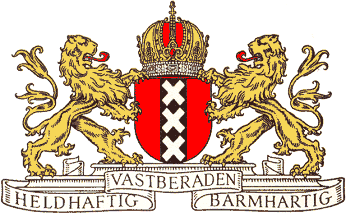
Heroic, Resolute and .....Charitable
|
1200-1580 The foundation
... About 1200 A.D., Amsterdam
developed
round a dam in the river Amstel.
The name Amstelledamme occurs for the
first time in the toll concession of Floris V,
Count of Holland, dated October 27, 1275.
So we can say Amsterdam is a young city !
While Rome and Paris were modern cities
with efficient infrastructures and universities
at that time, the first Amsterdam inhabitants
lived in cottages in a swampy environment. |
|
1580 -1672: The Golden Age |
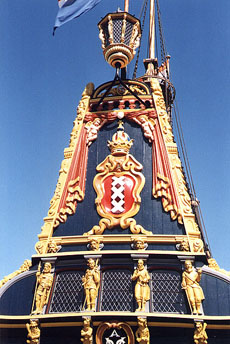 |
This period, the Golden Age, were the
days of Amsterdam's commercial success. Holland colonized Indonesia and in 1602 the VOC
was founded. The VOC (Verenigde Oostindische Compagnie)had to fight the enemies of the
Republic and prevent other European nations to enter the East India trade. During its
history of 200 years, the VOC became the largest company of its kind. Her factories
or trade centers were world famous: Desjima in Japan, Mokha in Yemen, Surat in Persia and
of course Batavia, the headquarters on Java. In
fact the VOC was the first Multinational Company in the world ! During 'The 80-year war' (the struggle to become independent from Spain),
Amsterdam build chips for the Dutch, as well as for the Spanish enemy and was not involved
in the war itself.
During this period the characteristic Amsterdam cityscape developed. |
1672-1795: The Dutch .. merchants and
clergyman at the same time ....
The year 1672 was a year of disaster for the Dutch Republic with the
French and English attacking simultaneously. The Golden Age had come to an end.
Nevertheless, Amsterdam managed to consolidate its prosperity during this period in spite
of the predicament the Republic found itself in. The city remained a major staple market
and managed to retain its position as the financial center of Europe.
The large number of dwellings built at this time, both simple ones
and rich canal houses, reflect the towns prosperity. As a result the majority of the
houses located in the city center date back to the 18th rather than the 17th century. |
1795-1813: Recession and Decline
In 1795 the government of the patrician oligarchies
was overthrown and the old Republic ceased to exist. Soon the French were to occupy the
country. Amsterdam suffered badly from the economic recession, a state of affairs
reflected by the stagnation of the demographic development. Many houses were vacant and
some even collapsed for lack of maintenance. Fortunately some facades and interiors dating
back to the Empire period survive today. |
1813-1940: Recovery and Expansion
This is marked by economic recovery and, from 1870
onwards, by expansion. Even in 1939 Holland was the second largest colonial power in the
world ! The increasing wealth brought about a rapid population growth. This development
was primarily the result of the Industrial Revolution. The city now ventured into the area
beyond the Singelgracht. Large poorly built working-class neighbourhoods were built. The
period 1920-1940 was a time of economic recession.
This was also the period of large-scale damage to
the historical city center; canals were filled in and new traffic breakthroughs were
realized. |
1940-1945 World war II
With the exception of a few misdirected allied air
raids, the city suffered little damage in terms of bombing or battles. But the large
Jewish community was decimated - deportation to the death camps literally cost Amsterdam
10% of its people. And the starvation winter of 1944/45, killed more.
The Jewish Deportations still are traumatic memory
to the Dutch people. It's sad and crazy that some journalist from today say ' the
Amsterdam people didn't avoid the deportations' ... they forget how brutish the Germans
punished people who did help the Jews ! Many families - like Anne Frank
and her family - went into hiding. Anne's world-famous diary tells their story. Eventually
the Frank family were betrayed and deported to Auschwitz. All died with the exception of
Anne's father.
The defeat of the British and Polish airborne forces
at the Battle of Arnhem in 1944, isolated the northern part of the Netherlands. With the
German armies under pressure on all fronts, supplies dried up. The starvation winter of
1944-45 claimed countless lives in Amsterdam. To get wood to fuel their fires, people
pulled down thousands of empty houses - often those of deported Jewish families. Germany
surrendered on 5 May 1945, and two days later Canadian troops liberated Amsterdam. |
1945-1970 The New Spirit ...
After the war, the city faced the challenge of
revitalizing its two most important generators of prosperity ,the sea- and air-ports.
There was a housing backlog to be cleared away, and the city's roads would have to be
rebuild to cope with growing traffic.
Schiphol airport grew apace and now ranks high among
European airports in terms of volume - and higher in terms of service. Obviously this
expansion has had a positive and a less-positive impact on the nearby city. Meanwhile,
enhancing Amsterdam's access to the North Sea was an ongoing priority. The harbor mouth,
canals and locks were regularly enlarged and improved.
With the independence of the former Dutch colony
Indonesia (after a doubtful 3 year during military intervention ... the Dutch
Administration scared a communist regime in Indonesia), many Indonesian people came
to Holland they were the forerunners of the present multicultural and colored
Amsterdam !
But when prosperity grew in the 'sixties', many
people worried about the quality of life. The young were finding that they had a voice,
and they were using it to challenge the traditional hierarchy. It was the time the 'Provo'
movement, flower-power and protest. John Lennon and Yoko Ono had their legendary sleep-in
at the Amsterdam Hilton. The explosion of youth culture in Amsterdam hit the headlines
worldwide. Hippies and back-packers flocked to the city. They slept in the Vondelpark and
even around the national monument on Dam Square until this was banned in 1970. This
"right wing trick" choked the progressive part of Holland and it set off a era
of left wing mayors in Amsterdam. |
1970- now ..
Ever since the early 'sixties two conflicting ideas
on Amsterdam have struggled for mastery - business and productivity versus livability and
living space. One - business-driven - school of thought wanted up scaling of Amsterdam as
a product in its own right, and as a center of production. Opposed to this was an ideal of
the city as a place to live and meet, as a hot-house for new ideas. All this was happening
at a time of fundamental change in Dutch society.
Livability is the priority, but Amsterdam has never
down-played its relish for business. The rich opportunities are evidenced by the number of
major international corporations choosing the Amsterdam region as their European gateway.
Today's slogan is Holland Main port / Brain port, so major attention to trade, research
and education. There are two Amsterdam universities: University Of Amsterdam and De Vrije
Universiteit
Today's cultural picture is as dynamic and vibrant
as ever, but politicians and citizen are faced with the problems of these times: senseless
violence to people, drug abuse and the gradual isolation of people. |
ALRAC
communications 25-04-02 |
